
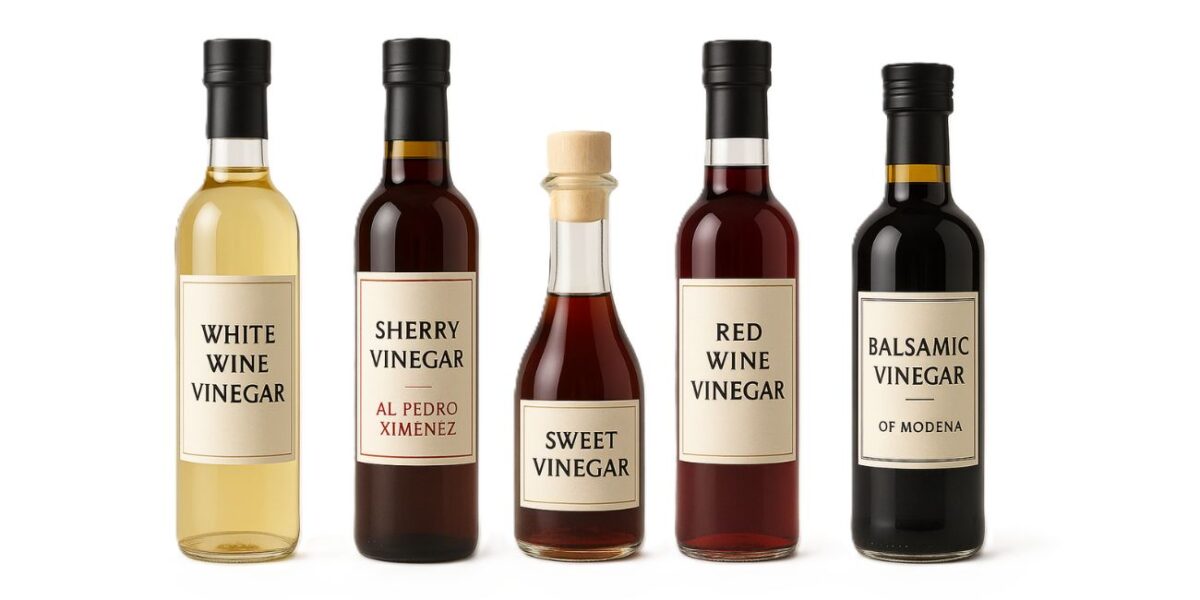
1. The Essence of Wine Vinegar
Among the many vinegars found in kitchens worldwide, wine vinegar—whether red or white—occupies a special place in both culinary tradition and industrial food processing. At its core, wine vinegar is not wine; it is the result of wine that has undergone a complete secondary fermentation known as acetous oxidation, wherein the ethanol of the wine is transformed into acetic acid through the action of Acetobacter bacteria.
This process, known in Islamic jurisprudence as istiḥālah—chemical transformation—renders the substance a new creation in both nature and ruling. The transformation removes its intoxicating quality, turning what was once ḥarām (khamr) into a new, pure, and non-intoxicating product. Hence, in the Ḥanafī school—and by extension, in AskHalal’s standard based, wine vinegar is ḥalāl, provided it is not adulterated with any untransformed wine or alcoholic additions.
2. How Industrial Vinegar is Made
Modern industrial vinegar production almost universally relies on acetous fermentation tanks, where a wine or ethanol base is aerated and oxidized under controlled conditions until the residual alcohol level drops below 0.5%.
Once complete, the resulting liquid meets regulatory definitions of vinegar across jurisdictions such as the EU and North America, which stipulate a minimum acidity (5–7%) and a negligible alcohol content.
Commercial white wine vinegar, red wine vinegar, and spirit vinegar sold in supermarkets are therefore all, by default, the product of complete acetification—no intoxicating residue, and no ongoing fermentation. Thus, such products, when labeled simply as “wine vinegar” without any modifiers, are to be considered ḥalāl.
3. The Rise of Gourmet and Specialty Vinegars
However, in the realm of gourmet and artisanal condiments, manufacturers often go beyond the baseline definition of vinegar to produce complex, nuanced flavors. Some of these premium products are not merely fermented wine, but blends of vinegar with added wine, grape must, or sweet fortified wines—each reintroducing an element of khamr back into the otherwise ḥalāl vinegar base.
Let us examine these in detail.
4. Sherry Vinegar “al Pedro Ximénez” and “al Moscatel”
In southern Spain, the Vinagre de Jerez (Sherry Vinegar) is protected by a PDO (Protected Designation of Origin). Under its 2012 regulation, producers are legally permitted to add small amounts of sweet sherry wines such as Pedro Ximénez (PX) or Moscatel to matured vinegar. These styles are labeled as:
- Vinagre de Jerez al Pedro Ximénez, or
- Vinagre de Jerez al Moscatel.
This addition, known as aromatización or dulcificación, enhances the sweetness and aroma of the vinegar. Yet, in Sharīʿah terms, it also means that wine is being added back after the vinegar has already been formed. The added PX or Moscatel wine is not re-acetified—it remains a sweet khamr component introduced for flavor.
Thus, these types fall outside the boundary of istiḥālah, as a portion of wine is deliberately reintroduced, and therefore, they are ḥarām.
5. “Dulce,” “Condimento,” and Other Sweetened Vinegars
Several Italian and Spanish manufacturers market “vinagre dulce” (sweet vinegar) or “condimento di vino”, produced by adding grape must or wine concentrate to finished vinegar. In some cases, this must is only partially fermented or not fermented at all. In others, it is a blend of vinegar with unacetified wine.
These products aim to imitate the smoothness of balsamic vinegar, creating a rounded, sweet-acidic profile. However, from a Sharīʿah perspective, the critical question is whether the additive—wine, must, or concentrate—has undergone istiḥālah (complete transformation).
If the must or wine is added after the vinegar is complete, and it remains unoxidized, then the final product contains khamr elements. Therefore, such sweetened or blended condiments are ḥarām unless the manufacturer provides clear certification that the entire blend has been re-acetified, eliminating alcohol content entirely.
6. Regulatory Clues and Residual Alcohol
European regulations reinforce this distinction. For example:
- Ordinary wine vinegar must contain no more than 0.5% ethanol.
- Vinegars made from fortified or sweet wines may legally retain up to 3% ethanol.
Hence, in some gourmet vinegars, a small but deliberate retention of wine alcohol is allowed for sensory balance. These styles are distinct from the pure fermented vinegars found in commercial trade.
7. AskHalal’s Position
After examining the manufacturing data and jurisprudential principles, AskHalal adopts the following stance:
1. Halāl (Permissible)
- Regular White Wine Vinegar and Red Wine Vinegar, produced by complete acetous fermentation of wine, with no additional wine or must added afterward.
- This includes all standard supermarket vinegars labeled simply as “wine vinegar” or “white wine vinegar,” provided no other alcoholic ingredients are listed.
- Purity here is established by istiḥālah—the complete transformation of khamr into vinegar.
2. Ḥarām (Impermissible)
- Any vinegar product to which wine, fortified wine (e.g., Pedro Ximénez, Moscatel, Marsala), wine concentrate, or grape must is added after fermentation to modify sweetness or aroma.
- Common examples:
- Vinagre de Jerez al Pedro Ximénez / al Moscatel
- Vinagre Dulce (Sweet Vinegar)
- Condimento di Vino or Condimento Dolce
- Balsamic Condiments with added wine.
- Such additions reintroduce khamr into the final product and break the condition of istiḥālah.
3. Mashbūh (Doubtful)
- Products labeled with ambiguous terms such as “sweetened vinegar,” “aromatized,” “condiment,” or “wine-must blend.”
- Unless the producer explicitly confirms complete re-acetification of the blend (e.g., certified 0.0% alcohol and halal/vegan claim), these should be treated with caution.
8. The Consumer Rule of Thumb
If the label says simply “Wine Vinegar” (white or red) and lists no other additives—it is ḥalāl.
If the label mentions “Pedro Ximénez,” “Moscatel,” “Sweet,” “Dulce,” or “Condimento,” then avoid unless certification proves that all added components were re-acetified and contain no residual ethanol.
9. Conclusion
The Sharīʿah ruling on wine vinegar hinges not on its name but on its composition. Where complete transformation (istiḥālah) has taken place, purity and permissibility are restored; where wine or its derivatives are added afterward, the impurity is renewed.
AskHalal therefore recognizes:
“All ordinary commercial wine vinegars—white or red—are ḥalāl by istiḥālah, while gourmet or sweetened variants that include added wine or grape must are to be avoided.”
References:
- eAmbrosia PDO Register – Vinagre de Jerez (live entry page) EU register entry for the Vinagre de Jerez PDO (status, dossier pointers). (https://ec.europa.eu/agriculture/eambrosia/geographical-indications-register/details/EUGI00000013883)
- Vinegars of Europe (industry body) – Vinagre de Jerez PDO profile. Background on PDO rules and production; confirms sherry wine basis and regulated specs. (https://vinegars.eu/production/pdo-pgi-vinegars/vinagre-de-jerez-pdo/)
- France – Vinegar Decree (Legifrance, consolidated). Sets residual alcohol limits: generally ≤0.5% vol. for vinegars (other than wine vinegar); wine vinegar ≤1.5%, and up to 3% for vinegars from fortified/sweet wines.(https://www.legifrance.gouv.fr/loda/id/LEGIARTI000006564259/1988-12-31)(fallback consolidated page: https://www.legifrance.gouv.fr/loda/id/JORFTEXT000000867411)
- OIV Compendium – “Residual alcohol content in vinegars” (method OIV-MA-VI-05) Defines and standardizes how residual ethanol in vinegar is measured.(https://www.oiv.int/sites/default/files/publication/2023-05/Compendium%20MA%20Vinaigre%20complet_EN.pdf)
- Vinegars of Europe – Fermentation Process (semi-batch details). Notes operational set-points (e.g., discharge at ~0.3% residual alcohol), evidencing complete acetification in standard practice.(https://vinegars.eu/production/fermentation-process/)
- Eurofins chapter “Vinegar” (industry/analytical review) Technical overview; also references trade associations and authenticity issues. (https://cdnmedia.eurofins.com/european-west/media/12153894/26_chapter-vinegars_final.pdf)
- Foods & Wines from Spain – Vinagre de Jerez PDO. Government-backed promotional page summarizing PDO scope and specs. (https://www.foodswinesfromspain.com/content/icex-foodswines/en/food/products/vinegar—spices/vinagre-de-jerez-pdo.html)
- Academic/Technical monographs on vinegar production – UC Davis (Vinegar Fermentation overview PDF): (https://ucfoodsafety.ucdavis.edu/sites/g/files/dgvnsk7366/files/inline-files/192137.pdf) – Vinegars of the World (Springer chapter PDF): (https://link.springer.com/content/pdf/10.1007/978-88-470-0866-3_1)
- SANHA Pakistan vinegar fatwā – “The Sharīʿah Rules Regarding Vinegar,” SANHA Ḥalāl Associates Pakistan, 2017, pp. 1–9. (https://www.sanha.org.pk/wp-content/uploads/2019/03/The-Shari%E2%80%98ah-Laws-Regarding-Alcohol-2nd-edition.pdf)
Disclaimer:
The above article has been prepared under the full oversight and approval of the respected Muftī Ṣāḥib. The author may have utilized AI assistance for the purposes of language refinement, structural clarity, and improved coherence in English. However, the religious content and conclusions reflect the Muftī’s authoritative guidance.