
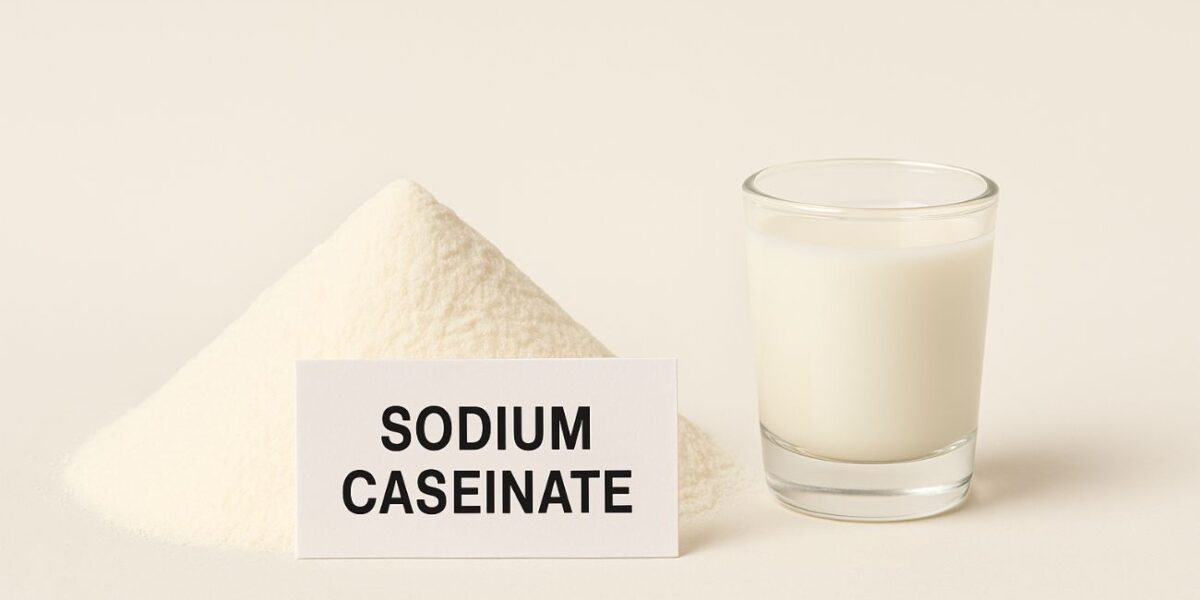
In the modern food industry, sodium caseinate is a widely used ingredient that often passes unnoticed on product labels. From coffee whiteners and processed cheese to nutritional bars and instant soups, this compound appears in a range of processed foods. But what exactly is sodium caseinate, how is it made, and—most importantly—how should it be viewed from a Sharīʿah compliance perspective?
What is Sodium Caseinate?
Sodium caseinate is the sodium salt of casein, the primary protein in milk. It is valued for its solubility and functional properties, such as emulsification, stabilization, and foaming ability. While pure casein is not soluble in water, converting it into sodium caseinate makes it readily dispersible, which is why it is so versatile in industrial food applications.
How It Is Produced
The production of sodium caseinate begins with extracting casein from skimmed cow’s milk. There are two principal pathways:
- Acid Casein Route: Skim milk is acidified, usually with hydrochloric acid or lactic acid, to precipitate casein. The resulting curd is washed, dried, and then neutralized with sodium hydroxide (NaOH) to yield sodium caseinate.
- Rennet Casein Route: Milk proteins are coagulated using rennet enzymes (traditionally chymosin extracted from calf stomachs, though microbial and recombinant rennets are also used). The curd is separated, washed, dried, and can subsequently be converted into sodium caseinate.
Both methods yield a product with similar technical properties, but the distinction is critical for Sharīʿah compliance.
Evidence of Rennet Use in Industry
It is sometimes assumed that acid precipitation is the sole or dominant pathway for sodium caseinate production. However, industry documentation shows that rennet coagulation remains in active use for casein production.
For instance, the industrial equipment supplier Flottweg explicitly notes:
“Casein is precipitated by adding rennet or mineral acid. Manufacture of casein by rennet precipitation … Enzymes, such as chymosin and rennet, thicken the pasteurized skimmed milk. … After deactivation of the enzymes, the coagulated casein is separated from the whey …” (Flottweg, flottweg.com)
NZMP, a major global dairy ingredient brand, markets rennet casein as a distinct product:
“Rennet Casein delivers maximum levels of body … With a neutral pH due to its production from rennet enzymes.” (NZMP, nzmp.com)
Ornua, another large supplier, states:
“Our casein / caseinate products include acid casein and rennet casein … Rennet casein is produced by enzymatic precipitation of casein from fresh pasteurised skimmed milk.” (Ornua, ornua.com)
Eurial Ingredients likewise describes their production method:
“Attrition-dried rennet casein is obtained through rennet enzymatic coagulation of fresh skimmed milk, separated from the whey.” (Eurial Ingredients, eurial-ingredients.com)
These statements confirm that rennet coagulation is not a relic of the past, but a continuing industrial practice. Academic sources also corroborate this. For example, Shah et al. note in their study on cheese analogues:
“Rennet casein is produced by coagulating rennets with skim milk at 30 °C … the casein micelles are converted into gel, and whey is separated …” (ResearchGate)
North American Context
While the earlier references established that rennet casein continues to be produced in Europe, New Zealand, and elsewhere, it is also important to note that North American markets provide indirect but significant evidence of the same. Trade data shows that both the United States and Canada remain engaged in rennet casein commerce.
The U.S. Department of Agriculture reports on casein markets weekly, noting specifically:
“Rennet casein prices were unchanged this week. … In Europe, increasing milk output is contributing to an uptick in rennet casein production.” (USDA, ams.usda.gov)
Market analysis further confirms that rennet casein is not marginal but a major share of the North American industry:
“The rennet casein segment held the largest share of the North America casein market of 58.6% of total consumption in 2024.” (marketdataforecast.com)
In Canada specifically, Cognitive Market Research notes:
“The Canada Rennet Casein Market had a market share of USD 24.68 million in 2024.” (cognitivemarketresearch.com)
Additionally, an industry editorial reviewing U.S. history of casein production observes:
“While the U.S. once produced millions of pounds of casein, it has not produced any significant amounts since at least the 1960s.” (cheesereporter.com)
Although this last source suggests limited domestic manufacture today, the presence of an active North American rennet casein market—particularly with Canada reporting measurable scale—supports the inference that rennet coagulation is still an active industrial practice in the region, even if not always explicitly disclosed by manufacturers.
The Shariah Compliance Concern
From a fiqh perspective, the concern lies in the source and nature of rennet:
- Animal Rennet: If obtained from non-halāl slaughtered animals or from pigs, its use in casein coagulation renders the product ḥarām.
- Microbial or Recombinant Rennet: These are enzyme preparations from microbial fermentation or genetic engineering. Their use is widely accepted as ḥalāl.
- Acid Casein Route: Since this relies only on acid precipitation, it is generally ḥalāl-suitable.
The complication is that the consumer cannot easily know which pathway was used. As industry references demonstrate, both acid casein and rennet casein are produced, and both can be further processed into sodium caseinate. The same suppliers often produce both types.
Furthermore, even when rennet is used, companies seldom disclose whether the rennet is microbial or animal-sourced. This lack of transparency creates a genuine doubt (shubha).
Detail Resolution
On the basis of these findings, the safe and precautionary stance is as follows:
- Default Position: Sodium caseinate is to be categorized as mashbūh (doubtful) unless explicit clarification is provided.
- Permissibility: If a manufacturer certifies that their sodium caseinate is produced via the acid precipitation route or by using microbial/recombinant rennet, it can be deemed ḥalāl.
- Impermissibility: If evidence shows that animal rennet from non-halāl sources was used in its manufacture, it is to be avoided.
This aligns with the Islamic legal principle of avoiding doubtful matters until clarity is achieved, as well as the AskHalal methodology of relying on predominant industry practices when clear but erring on caution when ambiguity is significant.
Conclusion
Sodium caseinate is technically derived from milk protein and, in many cases, may indeed be produced in a ḥalāl-suitable way. Yet industry documentation proves that rennet coagulation is still practiced, and that such casein can be used to produce caseinates. The absence of full disclosure on whether microbial or animal rennet was employed leaves us with uncertainty.
Resolution
Accordingly, sodium caseinate must be treated as mashbūh (doubtful) until proper verification is obtained from the manufacturer regarding its manufacturing process.
Disclaimer:
The above article has been prepared under the full oversight and approval of the respected Muftī Ṣāḥib. The author may have utilized AI assistance for the purposes of language refinement, structural clarity, and improved coherence in English. However, the religious content and conclusions reflect the Muftī’s authoritative guidance.