
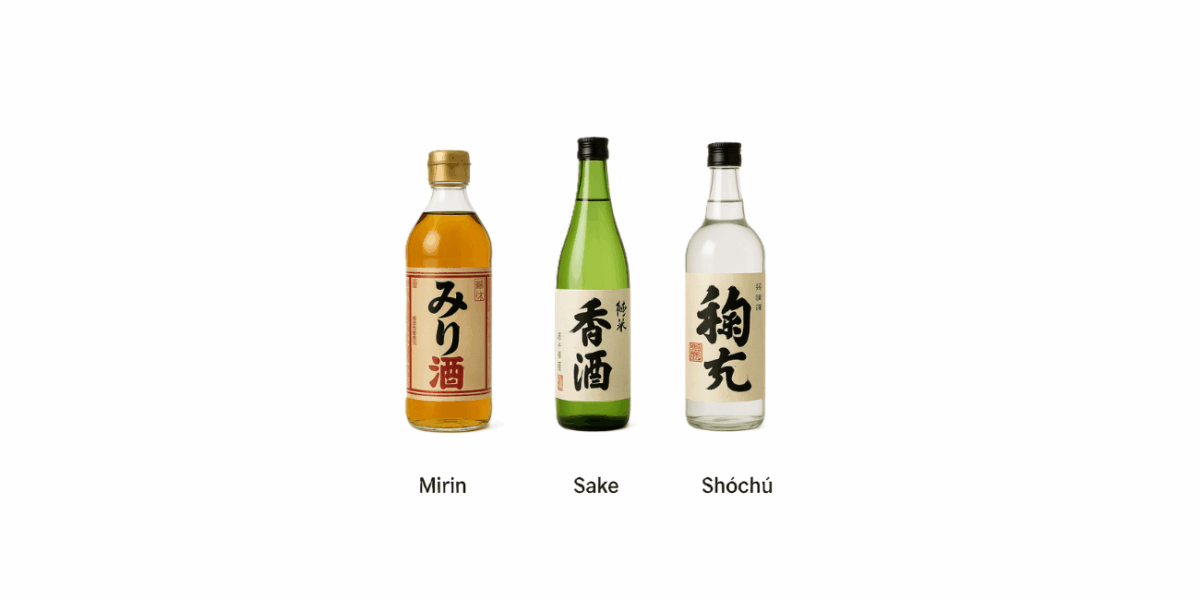
When evaluating Japanese alcoholic products under Islamic law, it is necessary to distinguish between their chemical nature, their origins, and how they are classified in the Hanafi school of jurisprudence. The three traditional Japanese alcohols most commonly encountered are mirin, sake, and shōchū.
Mirin is a sweet rice wine primarily used in cooking to impart sweetness and depth of flavor. Traditional mirin contains around 14% ethanol, obtained through rice fermentation combined with distilled spirit (shōchū). Although it is mainly used as a cooking ingredient rather than a direct beverage, it remains an alcoholic liquid. Under Hanafi fiqh, since it is derived from rice rather than grapes or dates, its alcohol is categorized as non-khamr. This means it is ṭāhir (not najis) but still impermissible to consume in its original form. While Hanafi jurisprudence technically tolerates non-khamr alcohols in minute, diminished traces within complex products, AskHalal standards dictate that where such alcohols are deliberately introduced as cooking ingredients, they take the ruling of general impermissibility.
Sake is the well-known Japanese rice wine, brewed from polished rice with the help of the koji mold. Its alcohol content usually ranges from 12–16%. Like mirin, its source is rice fermentation, not grapes or dates. Under the Hanafi framework, it too falls under non-khamr alcohol, meaning it is pure in substance but remains unlawful to drink. Its legal treatment parallels other fermented but non-grape beverages such as beer.
Shōchū is distinct in that it is a distilled beverage rather than simply fermented. With an alcohol content of 25–30%, it is stronger than sake and mirin and is commonly produced from rice, barley, sweet potatoes, or buckwheat. Being non-grape in origin, it is ṭāhir by Hanafi definition, but due to its intoxicating nature, it remains prohibited for consumption. Functionally, shōchū resembles vodka or rum in its strength and role.
Taken together, these three traditional Japanese alcohols highlight the Hanafi distinction between khamr and non-khamr. They are not classified as najis since they are not grape or date derived, but their deliberate use as intoxicant beverages or cooking additives renders them impermissible. This balance preserves the technical purity status while upholding the Qur’anic prohibition of intoxicants.
| Product | Alcohol Content | Source | Najis / Ṭāhir (Hanafi) | Halal Suitability (AskHalal Resolution) |
|---|---|---|---|---|
| Mirin | ~14% | Fermented rice + shōchū | Ṭāhir (non-khamr) | Ḥarām (used as an active cooking ingredient with significant ethanol content) |
| Sake | 12–16% | Fermented polished rice | Ṭāhir (non-khamr) | Ḥarām (intoxicant beverage) |
| Shōchū | 25–30% | Distilled from rice, barley, sweet potatoes, etc. | Ṭāhir (non-khamr) | Ḥarām (intoxicant spirit) |