
The matter of alcohol in oral-care products must be understood within the broader principles already laid down in our earlier ilmHub assessment: Assessing Broader Alcohols in Consumer Products.
That framework establishes that not every substance termed “alcohol” in industrial chemistry is the same as khamr (intoxicating beverage alcohol) in Sharīʿah. Contemporary commercial formulations frequently employ non-khamr alcohols or industrial ethanol as technical solvents, carriers, or preservatives rather than as intoxicating beverages.
From those standards, four interpretive pillars guide our present analysis:
- Differentiate khamr from non-khamr alcohols. Beverage alcohols (wine, beer, spirits) remain ḥarām, but technical or synthetic alcohols—especially those that are denatured—require contextual assessment.
- Judge by purpose, route, and effect. What is the intended function? Is it for intoxication, ingestion, or mere surface/technical application?
- Presume industrial or corn-sourced ethanol in modern consumer goods unless a beverage or wine source is clearly stated.
- Apply permissibility where the alcohol is not active as a drink. Technical use at low or controlled levels, not swallowed and not serving as an intoxicant, remains permissible—though precaution (iḥtiyāṭ) recommends alcohol-free alternatives whenever readily available.
2. Alcohol in Commercial Mouthwash Formulations
a. Functional Role of Alcohol
Industrial ethanol is frequently used in antiseptic mouthwashes at concentrations between 15 % and 27 % v/v. Its purposes are:
- Solvent and carrier: to dissolve and stabilize essential oils such as eucalyptol, menthol, thymol, and methyl salicylate—the actual antibacterial actives.
- Preservative: to maintain microbial stability and extend shelf life.
- Sensory effect: to impart the “tingle” sensation consumers associate with cleansing.
The bottles clearly instruct “rinse and spit—do not swallow.” This is despite the fact that while these alcohols are prepared to be averse for ingestion, intoxication can still be attained by their consumption.
b. Denaturation
Major manufacturers (e.g., Listerine) employ SDA 38-B, a specially denatured alcohol rendered undrinkable through additives. Denatured ethanol cannot serve as a beverage and therefore falls under technical, not khamr, classification. This would also mean that while one would find considerable discomfort consuming such mouthwash, leading to significant stomach pain, diarrhea, nausea, and vomiting.
c. Alcohol-Free Alternatives
Market research confirms abundant alcohol-free versions that achieve the same antiseptic purpose through cetylpyridinium chloride (CPC) or oxygenating systems. Thus, precautionary consumers can avoid ethanol entirely without losing oral-hygiene efficacy.
3. Sharʿī Analysis
a. Route and Intention
Mouthwash use is topical and expectorated. There is no intent nor act of ingestion, and therefore no intoxicating or recreational element.
b. Nature of the Substance
The ethanol employed is industrially denatured, not beverage-grade. By function and composition, it does not qualify as khamr.
c. Existence of Alternatives
Since alcohol-free options are widely available, Sharīʿah caution would advise choosing them when feasible. Nevertheless, ethanol-based products remain permissible when used strictly as intended.
4. Canadian Market Snapshot
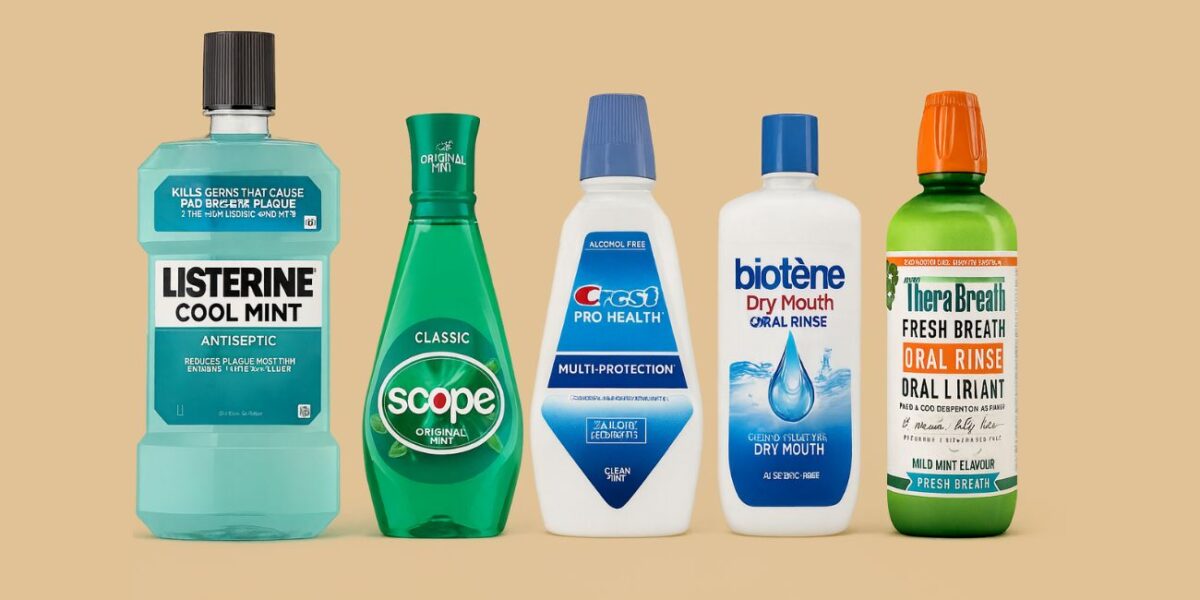
| Brand & Variant | Alcohol Content | Key Notes | Sharīʿah Assessment |
|---|---|---|---|
| Listerine Cool Mint Antiseptic | ~21–27 % v/v | Ethanol (denatured) solvent for essential oils | Discouraged use due to presence of high level alcohol. Permissible if rinse & spit only; alcohol-free preferred |
| Scope Classic Mint | ~15 % w/w | Alcohol acts as solubilizer/preservative | Same as above |
| Crest Pro-Health Multi-Protection/Advanced | None | CPC 0.07 % active; glycerin & poloxamer base | Fully permissible |
| Biotène Dry Mouth | None | Humectant blend (glycerin, xylitol, PG) | Fully permissible |
| TheraBreath Fresh Breath/Mild Mint | None | Oxygenating formula | Fully permissible |
(Data verified from manufacturer labels and Canadian retail listings.)
* This piece only looks at the element of Alcohol in their ingredient listing. Individual products should be viewed for their other ingredients as well.
5. Other Alcohol Types in Labels
Certain mouthwash or cosmetic labels list compounds such as cetyl alcohol, stearyl alcohol, benzyl alcohol, glycerin, or propylene glycol. These are non-intoxicating fatty alcohols or polyols derived from plant or synthetic sources. According to AskHalal’s classification, they are ṭāhir and have no Sharīʿah objection. (See: Assessing Broader Alcohols in Consumer Products)
6. Provisional Guideline from AskHalal (Sharīʿah-Compliance Standard)
- Default Ruling:
Alcohol-free mouthwash is preferable and should be adopted as a priority where ever available.
Ethanol-based mouthwash, when denatured and used only for rinse-and-spit, is technically permissible but not preferable when an alcohol-free option exists. - Red Lines:
• Any formulation citing wine, beer, or spirit-derived alcohol or designed for swallowing is impermissible.
• Swallowing mouthwash deliberately or in quantity is both ḥarām and medically hazardous; ethanol content (5–27 %) can intoxicate if ingested. - Label Cues:
• “Alcohol / Ethanol / SD Alcohol” → allowed only in rinse-and-spit use.
• “CPC” or “Alcohol-Free” → safest and preferred options.
References:
Canadian Dental Association – Mouthwash Products: (https://www.cda-adc.ca/en/oral_health/seal/products/)
Listerine Canada – Cool Mint Antiseptic: (https://www.cda-adc.ca/EN/oral_health/seal/products/product_page.asp?product=88)
Wikipedia – Mouthwash & Alcohol content article: (https://en.wikipedia.org/wiki/Mouthwash)
Wikipedia – Scope (Mouthwash) brand page (including denatured alcohol mention): (https://en.wikipedia.org/wiki/Scope_(mouthwash))
Disclaimer:
The above article has been prepared under the full oversight and approval of the respected Muftī Ṣāḥib. The author may have utilized AI assistance for the purposes of language refinement, structural clarity, and improved coherence in English. However, the religious content and conclusions reflect the Muftī’s authoritative guidance.